
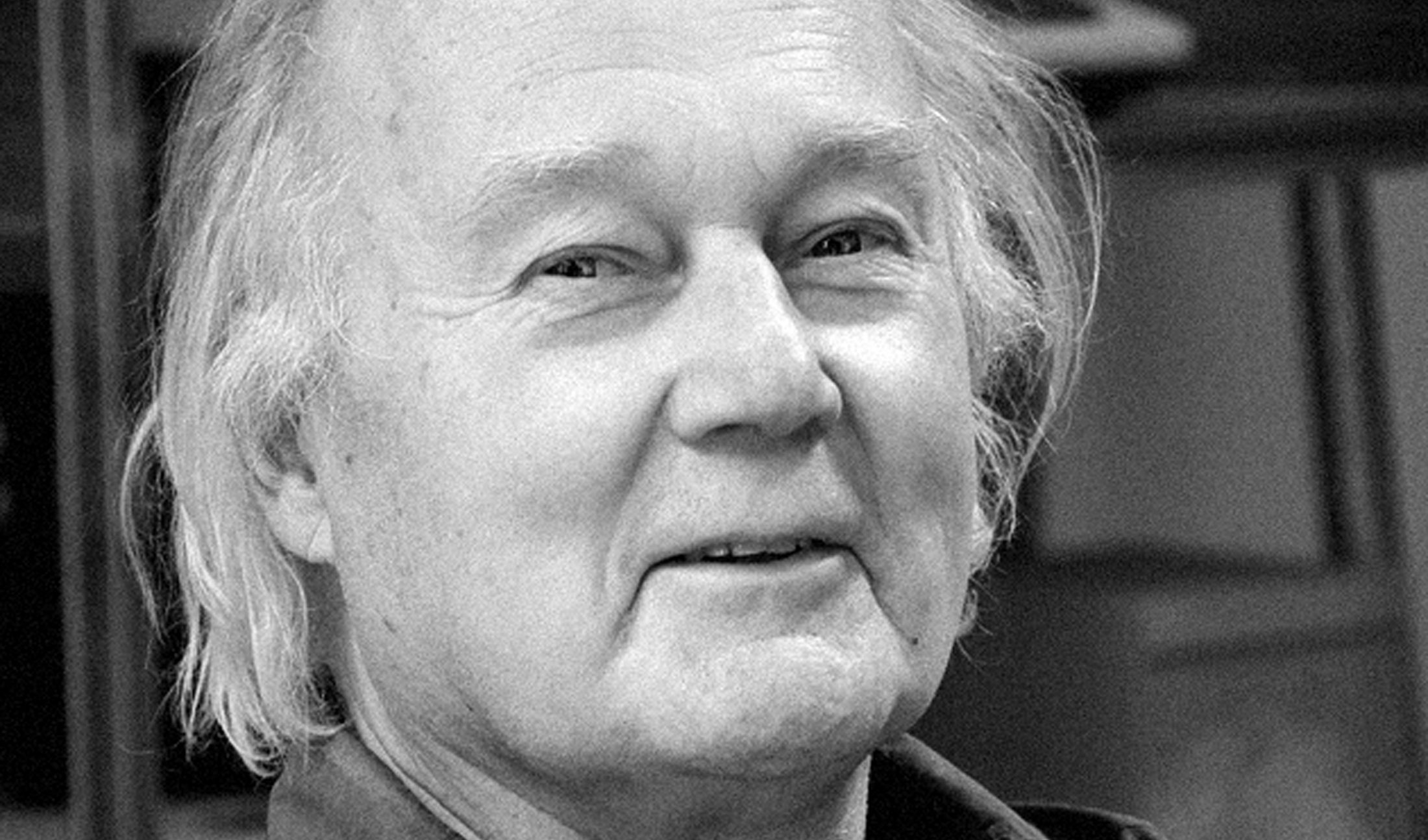
Gert Dumbar, whose career spans over 65 years, has consistently strived to elevate the standards of graphic design and visual communication, both within the Netherlands and abroad. As a provocateur, Dumbar believes that the authority and authenticity of graphic design derive from the quality of thought that informs the deed (read: the design solution), rather than from the deed itself. How one looks at and experiences a particular design problem determines the context or pattern of thought underlying the solution. According to Dumbar, the power of graphic design has as much to do with mentality as with creativity.
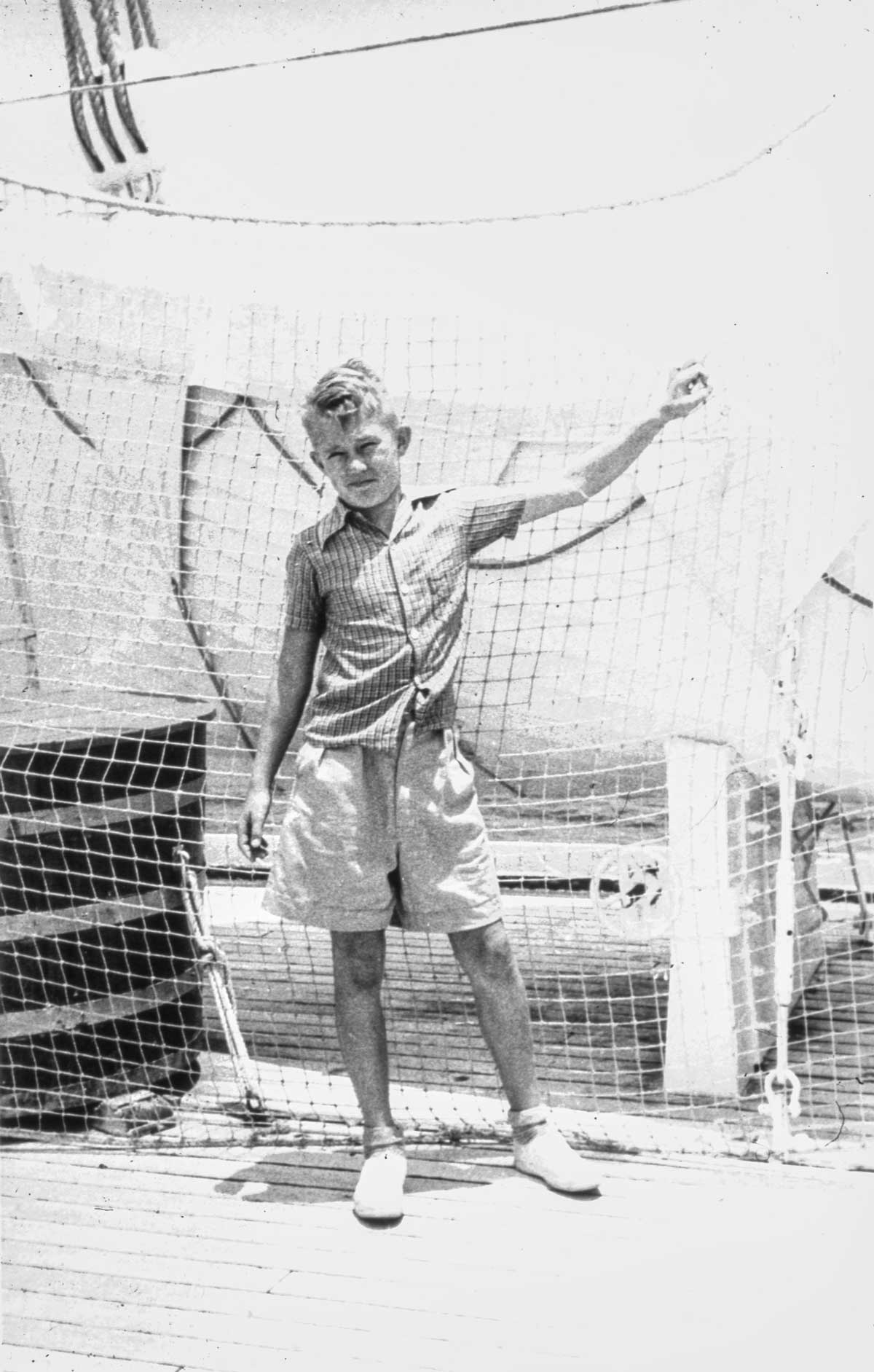
1952
On the boat from Indonesia to Holland
Dumbar was born in 1940 in Indonesia, where he lived for several years before emigrating “home” to the Netherlands with his family. The resulting dichotomy of place—the lush tropics with their full spectrum versus the more ascetic, monochromatic north—has since influenced how he perceives and reacts to the world. In fact, Dumbar’s work as a graphic designer can be characterized by an inherent desire to reconcile the irreconcilable: a word is not an image, no object is no word. His design solutions—indeed, how he sees and experiences the world—embody the necessary dialectic between opposing (exquisitely human) forces: order/disorder, utility/ornament, reason/emotion, restraint/freedom, conformity/rebellion, and so forth.
Gert Dumbar hails from a family of civic-minded free-thinkers, some of whom, trained as barristers, were iconoclasts in their own right (for instance, advocating fair play at a time when such notions were considered naive and, worse, detestable). In the environment in which he grew up, debate was regarded as a means of unearthing one’s passions and beliefs while putting them to the test; less as a vehicle of contention and more as a tool for sharpening one’s own mind. Not surprisingly, Dumbar has always warmed to debate and encouraged it in others.
If debate is a tool, humor is a whetstone. In order to be truly liberated in thought and action, Dumbar contends it is essential to see the humor in all things. Humor is potent, penetrating, and memorable. It has nothing to do with propriety and decorum (the most delimiting of human conceptions) and everything to do with essence. It opens the mind to incongruities and peculiarities, which, in turn—if one stays open—make way for the discovery of stirring analogies, the stuff of successful communications. Dumbar is, in many ways, a master humorist.
When Dumbar enrolled at the Royal Academy of Fine Arts in The Hague, he harbored ambitions of becoming an artist. His grandmother, an experienced painter, served as his inspiration, and Dumbar initially intended to follow in her footsteps. However, he was soon captivated by the resounding influence of the late Dutch designer Paul Schuitema, whose pioneering spirit in the early twenties helped elevate the practice of graphic design to a fully-fledged discipline. Fascinated by Schuitema’s dynamic energy, Dumbar veered away from painting and delved into design. (Here lies another implicit duality in Dumbar’s character and consequently, in his work: the personal artist and the public designer). He completed his studies in the postgraduate program of graphic design at the Royal College of Art in London, then under the guidance of the English designer (and fellow renegade) Anthony Froshaug.

1965
Royal College of Art, London
Many years later he returned to the Royal College of Art as a visiting professor, heading the graphic design department from 1985 to 1987 and again in 2000. Other academic appointments include the University of Bandung in Indonesia, where he taught periodically and has taught since 1996 at the Hochschule der Bildenden Künste Saar in Saarbrücken, Germany, where he was a visiting professor from 1996 to 1998, the Cranbrook Academy of Art in Detroit , USA, and Design Labor in Bremerhaven, Germany, where he served on the board of directors from 1997 to 1999.
Dumbar is frequently invited to give lectures at art academies and speak at international design conferences. He has served on several influential juries, including two appointments by the French government: to sit on the jury alongside the renowned American architect I.M. Pei (the designer of the glass pyramid for the Louvre), and to join the jury for the corporate identity and signage for the Bibliothèque Nationale in Paris. He was invited by the German government to be part of the International Design panel for the corporate identity of the World Expo 2000 in Hannover, Germany, along with the Italian architect and designer Alessandro Mendini, the German painter A.R. Penck, and the American designer April Greiman. Dumbar served as chairman.
From 1968 to 1977, he was a partner at the design firm Tel Design before founding Studio Dumbar in 1977, which quickly grew into one of the most influential studios in the Netherlands. This success is not only attributed to the talent and ingenuity of Gert Dumbar but also to his former colleagues Michel de Boer and Kitty de Jong, who were his partners for over twenty years. De Boer, alongside Dumbar, was responsible for the creative activities of the studio, while De Jong managed the commercial operations. Studio Dumbar, headquartered in The Hague, had branch offices in Rotterdam, established in 1996 under the leadership of Henri Ritzen, in Frankfurt, opened in 2000 under the guidance of Tanja Backe.
In 1996, Dumbar conceived and spearheaded the traveling exhibition ‘Behind the Seen,’ showcasing the work of Studio Dumbar. To date, the exhibition has been displayed in the Netherlands – where it debuted at the Rotterdam Kunsthal – as well as in Frankfurt and Bremerhaven, Germany; Tokyo and Osaka, Japan; Detroit, USA; Toronto and Montreal, Canada; Shanghai and Beijing, China; and Melbourne, Australia. Verlag Hermann Schmidt Mainz published the accompanying catalogue raisonné titled ‘Behind the Seen’.
The work of Studio Dumbar has been included in the collections of numerous museums around the world.
Gert Dumbar serves as the chairman of the British Designers and Art Directors Association (D&AD) and has been a longstanding member of the design board of British Rail. In 1990, he was honored with an Honorary Fellowship from Humberside Polytechnic in Hull, England. Since 1994, he has held the title of honorary member of the Asociacion de Disenadores Graficos de Buenos Aires (ADG), and in 1995, he was awarded an honorary doctorate in design from the Southampton Institute in England. He is a member of the Alliance Graphic International (AGI) and has previously chaired the Dutch Association of Graphic Designers (BNO), of which he is now an honorary member.
2010, he was appointed as an Officer of the Royal Order of Orange-Nassau in recognition of his exceptional contributions of both national and international significance.
A preference for the avant-garde and a disdain for formal classifications led Dumbar to co-found the pioneering Zeebelt Theater in The Hague, a platform for experimental artistic expression. The programming ethos is multidisciplinary, aiming primarily to foster debates on the cultural and social responsibilities of artists: visual artists, designers, architects, composers, playwrights, poets, and writers.
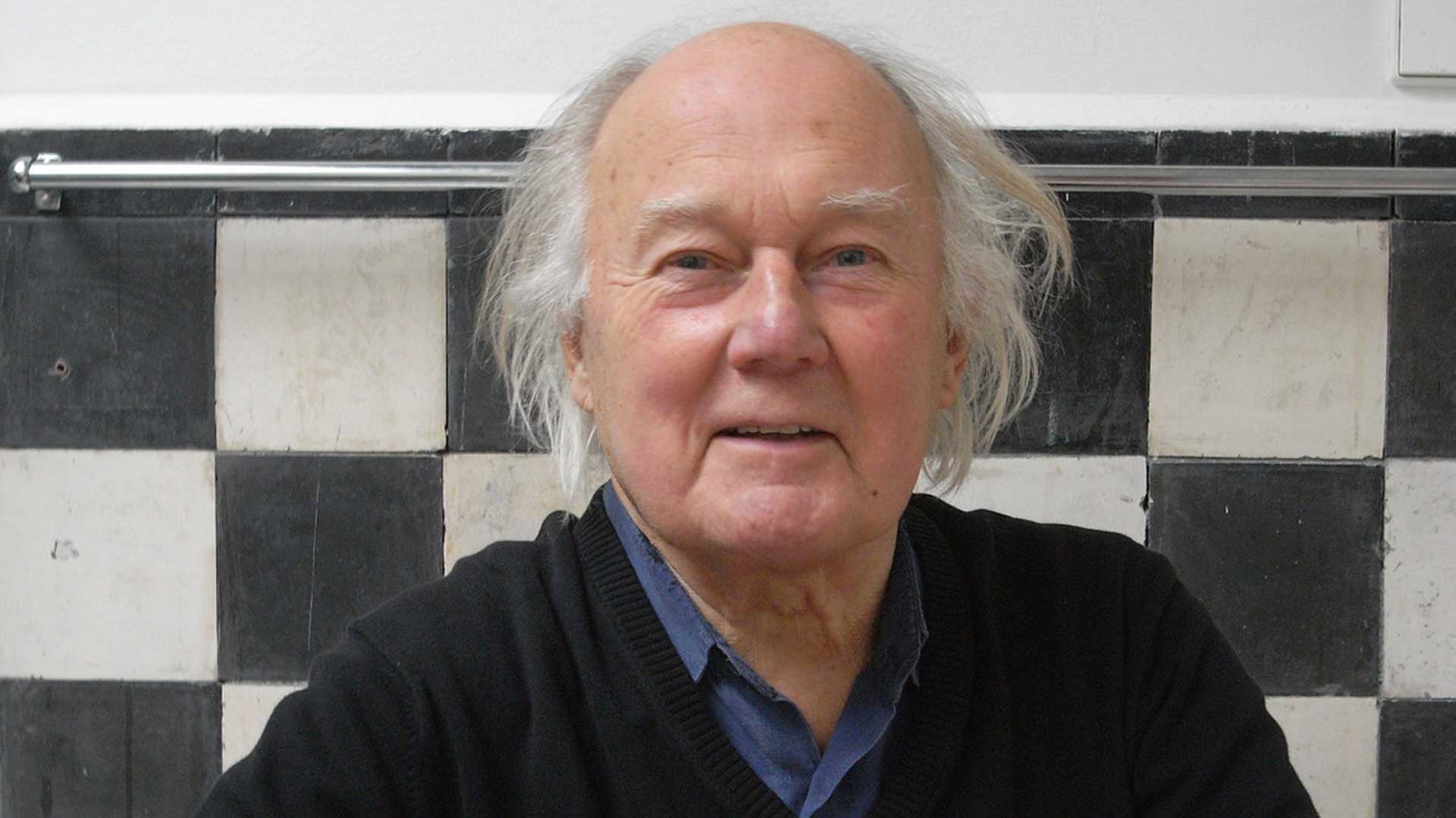
2021
The Hague
Gert has since left Studio Dumbar and occasionally works as a freelancer. He still teaches, two days a week, at the Royal Academy of Fine Arts in The Hague.
He teaches 2 classes:
- “Humor as a Strategy for Design.”
- An annual collaborative project between students of the Royal Academy of Fine Arts and students of the Royal Conservatoire in The Hague.
Gert Dumbar is married and has two children, a daughter, a son, and a grandson. In his leisure time—much of which he spends in the idyllic setting of rural France—Dumbar divides his attention between restoring French motorcycles from the early 20th century and cultivating classic English roses.